Yahoo! Auctions Japan: The Watch Collector’s Guide
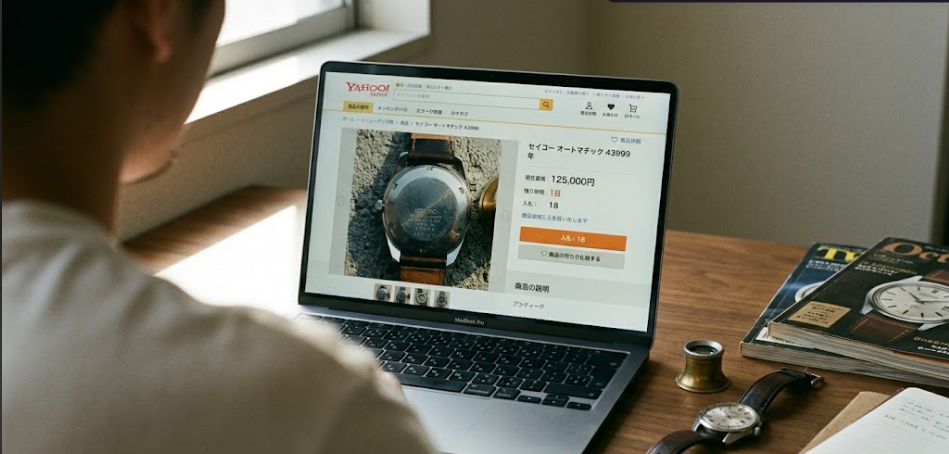
Every serious vintage Japanese watch collector, at some point, ends up in the same place: staring at a Yahoo Auctions Japan listing for a watch they've been looking for, and working out how to actually buy it.
Yahoo Auctions Japan — known domestically as ヤフオク! (Yahuoku) — is not a niche platform. Launched in 1999 as Japan's first online auction site, it saw off both eBay Japan (which launched in 2001 and withdrew in 2002, unable to compete) and Rakuten's auction service (discontinued in 2016). What remained is Japan's undisputed dominant secondhand marketplace, with over 100 million active listings and millions of items transacting daily. In the watch category specifically, it is simply without peer. The depth of inventory, the breadth of references that appear, and the condition standard of what gets listed are all meaningfully better than any equivalent platform operating internationally.
The catch is obvious: the platform is built for Japanese domestic users. Most of the interface is in Japanese. Sellers expect to deal with buyers in Japan. Payment requires Japanese financial infrastructure. And until relatively recently, international collectors had to find creative routes around these restrictions.
This guide explains how the platform actually works, what those routes look like, how to read a listing, and where the real risks are when buying watches through it from abroad.
What Yahoo Auctions Japan Is — and Why It Matters for Watches
Yahoo Auctions Japan sits at the intersection of two things the watch collecting world cares about: deep inventory and high condition standards.
The inventory depth is structural. Japan has one of the world's strongest domestic watch markets, particularly for Japanese brands. Seiko, Grand Seiko, Citizen, Orient, and Casio have maintained domestic retail networks for decades, and the secondhand circulation of these watches flows primarily through Japanese channels. JDM (Japanese Domestic Market) references — watches produced exclusively for the home market, not distributed internationally — exist in meaningful volume on Yahoo Auctions Japan and almost nowhere else with regularity. When a Seiko SARB065 "Cocktail Time" or a vintage 6139 Speedtimer surfaces in unpolished, honest condition, it is far more likely to appear on Yahoo Auctions Japan than on eBay, Chrono24, or any regional dealer platform.
The condition standard reflects something particular about Japanese secondhand culture. Japanese consumers treat pre-owned goods with a seriousness that is genuinely unusual by international comparison. Watches sold as "used" on Yahoo Auctions Japan are routinely what Western sellers would describe as very good to excellent. The market has its own grading language (covered below) and its own expectations of seller honesty, and those expectations hold more than they fail.
For the collector outside Japan, this combination — distinctive inventory, strong condition — makes Yahoo Auctions Japan the correct place to start any serious search for vintage Japanese watches. The friction of accessing it is real, but it is navigable.
How the Platform Works
Auction Format and Mechanics
Yahoo Auctions Japan operates on a familiar auction model. Sellers list items with a starting bid, a minimum bid increment, and an auction end time. The highest bidder at close wins the item and proceeds to payment and domestic shipping.
Several mechanics distinguish it from eBay, and collectors should understand them:
Proxy bidding is standard. Buyers enter a maximum bid limit, which the system uses automatically — bidding up to that ceiling only as needed to remain the highest bidder, never revealing the ceiling to other participants. This is identical to eBay's system and means the final price is often considerably below a buyer's stated maximum.
The last-five-minute extension rule prevents sniping. If any bid is placed in the final five minutes of an auction, the closing time automatically extends by five minutes. This continues until five minutes pass with no new bids. In practice, it means competitive auctions almost always run longer than their stated end time. Collectors accustomed to auction sniping tools will find this changes strategy significantly; the extension rule shifts competitive auctions toward a more genuine last-bidder-wins format.
"Buy It Now" (即決価格, sokketsukakaku) exists alongside auctions. Many listings offer a fixed buy-now price that allows immediate purchase without the auction process. For watch collectors, this is useful when a specific reference appears at an acceptable price and the risk of being outbid during a multi-day auction is undesirable. Buy-now listings can also be negotiated on some platforms.
Auction durations are typically five to seven days. Fixed-price listings may close immediately on purchase.
Seller Ratings and Trust Infrastructure
Yahoo Auctions Japan uses a buyer/seller feedback system analogous to eBay's. Sellers accumulate positive, neutral, and negative ratings from past transactions. High-volume sellers with consistently positive ratings are the safest counterparts for significant purchases.
The Japanese market's cultural emphasis on transactional honesty means outright fraud is substantially rarer than on international platforms. The more common risk is not deliberate deception but condition description that is incomplete — a scratch mentioned but not photographed, a movement issue undisclosed because the seller genuinely doesn't know how to assess it. These are different problems, and they inform how listings should be read.
Reading a Watch Listing: What the Japanese Says
This is where most international buyers hit the first real wall. A Yahoo Auctions Japan watch listing is almost entirely in Japanese, and automated translation tools — Google Translate, DeepL — get you most of the way there but not all of it.
Condition Grading Terms
Japanese sellers on Yahoo Auctions Japan use a shared vocabulary for condition that is self-declared but largely consistent across the market. Understanding these terms is the single most important skill for avoiding costly mismatches.
The key condition grades, from best to worst:
- 新品 (shinpin) / 未使用 (mishiyou): New / Unused. Shinpin means brand new; mishiyou means unused but not necessarily in original packaging. An unused watch may have been unboxed, stored for years, and lost its accessories. These are not always interchangeable.
- S ランク / N ランク: S-rank or N-rank. Like new, essentially unworn. Factory state.
- A ランク: Excellent condition. Minimal signs of use, barely worn, no meaningful scratches.
- AB ランク: Good, with light signs of normal use. Very common for well-cared-for watches.
- B ランク: Normal wear visible. Scratches present but not detracting from function or significant appearance.
- C ランク: Obvious wear, scratches, or dents. Still functional but cosmetically compromised.
- ジャンク (junk) / J ランク: Junk. This is the critical term. A junk listing explicitly removes any guarantee of functionality. The seller is stating the watch is sold with no returns and no warranty of working condition. This does not mean the watch is unwearable — many junk listings are functional watches listed conservatively because the seller doesn't know how to test them, or because a complication (alarm, chronograph, automatic winding) wasn't confirmed working. But proceed with full understanding that junk means exactly what it says.
Beyond the grade, the listing description body will typically itemise specific condition disclosures: scratches on the crystal, marks on the case, stretched bracelet links, condition of the lume, presence of service history. These disclosures are the most important text in any listing and deserve careful translation rather than a quick skim.
The dial code (discussed in authentication contexts) and the caseback reference number, when visible in photographs, can be cross-referenced against documented production data to verify the specific reference independently of the seller's description.
Key Vocabulary for Watch Listings
Some Japanese terms appear constantly in watch listings and are worth knowing directly rather than relying on translation:
| Japanese | Meaning |
|---|---|
| 文字盤 (mojiban) | Dial |
| ケース (ke-su) | Case |
| 風防 (fubou) | Crystal/glass |
| 竜頭 (ryuzu) | Crown |
| ブレスレット (buresuretto) | Bracelet |
| 外箱 (sotobako) | Outer box |
| 保証書 (hoshousho) | Warranty card / papers |
| 動作確認済み | Operation confirmed (watch verified running) |
| 日付け表示 | Date display |
| 稼動品 | Working item |
| 訳あり (wakuari) | "With reason" — an item with known flaws, disclosed |
| ノークレームノーリターン | No claims, no returns (common on junk listings) |
Learning these terms, or keeping a reference list handy, makes navigating listings considerably more efficient than relying entirely on automated translation.
The Access Problem: Why International Buyers Can't Transact Directly
Yahoo Auctions Japan restricts purchases to users with a Japanese address and Japanese payment methods. Creating an account is possible for international users, but completing a purchase requires a Japanese address for delivery — most domestic sellers do not ship internationally — and compatible payment infrastructure. This has been the consistent position of the platform, and it has not meaningfully changed for international buyers despite various discussions of international access programmes.
The practical result: international collectors access Yahoo Auctions Japan through proxy services.
How Proxy Services Work
A proxy service is a company based in Japan that acts on a buyer's behalf: bidding or purchasing from a Japanese address, receiving the item at their warehouse, performing a basic condition check, and then forwarding internationally.
Well-established proxy services used by watch collectors include Buyee (which has an official integration partnership with Yahoo Auctions Japan and provides an English-language interface over the platform), FromJapan (which has operated since 2004 and is widely used among serious collectors), Remambo, and ZenMarket, among others.
The general flow for a proxy purchase:
- Browse Yahoo Auctions Japan through your proxy service's search interface or directly at auctions.yahoo.co.jp (translating with browser tools).
- Place a bid or buy-now request through the proxy. They bid from their Japanese account.
- If you win, the proxy pays the seller and provides a Japanese delivery address.
- The item arrives at the proxy's warehouse. Most services photograph what arrives; some offer basic inspection at request.
- You confirm the item and the proxy arranges international shipping.
The cost structure includes: the item price, a proxy service fee (typically a percentage of item value or a flat fee per transaction, varying by service), domestic Japanese shipping from seller to proxy warehouse, and international shipping. On a mid-range watch purchase, proxy overhead and international shipping might add the equivalent of $30–$80 USD, depending on the service, package weight, and shipping method chosen. This is a real cost that should be calculated before bidding, not after winning.
Buyee's Official Relationship with Yahoo Auctions Japan
Buyee has a formal integration partnership with Yahoo Auctions Japan, which means its interface provides a cleaner browsing and bidding experience directly overlaid on the platform. For collectors new to the process, Buyee's English interface lowers the barrier to entry meaningfully. FromJapan offers a similar service and has a long track record among specialist collectors, particularly for vintage Grand Seiko sourcing. The Grand Seiko Guy — a Substack newsletter widely followed in the vintage Grand Seiko community — specifically notes using FromJapan for auction tracking and proxy purchasing.
A Note on UK and EEA Access
Since April 2022, Yahoo Auctions Japan has blocked direct access from the UK and the European Economic Area, citing the prohibitive cost of GDPR compliance for a relatively small user base. UK and EEA collectors cannot browse the platform directly and must access it entirely through proxy service interfaces. FromJapan provides links to auction listings that bypass this geo-block for viewing purposes, which is why it has become the default reference tool for UK-based vintage Grand Seiko collectors in particular.
What to Expect in Terms of Condition — and Where the Risks Are
The platform's condition standard is genuinely high relative to international equivalents, but this should not be read as a guarantee.
Fraud in the traditional sense — deliberate misrepresentation of a watch's identity — is genuinely rare. The rating system, the cultural context, and the legal environment in Japan combine to make outright dishonesty an unusual outcome. The more common issues are:
Incomplete condition disclosure. A seller who is not a watch specialist may accurately describe visible scratches but not know that a crown seal is compromised or that the automatic winding rotor is wearing unevenly. "Working" (稼動品) means the seller confirmed the watch runs; it does not mean it has been serviced or that it is running within specification. Vintage watches, even genuine ones in good cosmetic condition, should be budgeted for service.
Poor photograph quality concealing cosmetic details. This is the most persistent practical issue with Yahoo Auctions Japan watch listings. Japanese sellers are often conscientious about disclosing flaws they are aware of, but a low-resolution dial photograph doesn't reveal redials or lume restoration, and a single case photograph won't show all scratch angles. Requesting additional photographs through your proxy service, particularly of the caseback, crown, and any areas of concern, is always worth doing on higher-value pieces.
The "junk" listing opportunity. Counterintuitively, junk listings on Yahoo Auctions Japan can represent genuine opportunities. A watch listed as junk because the seller couldn't confirm the alarm function works, or because it hadn't been worn in a year and seemed to have stopped, is often in perfectly serviceable condition. Experienced collectors specifically monitor junk listings for well-presented references priced below market because of conservative seller caution. The risk is real — some junk listings are genuinely non-functional — but the pricing frequently reflects the conservatism of the designation more than the actual condition.
Competitive domestic bidding. The buyer pool on Yahoo Auctions Japan is overwhelmingly domestic, and Japanese collectors know their market. A vintage Seiko reference with collector following will attract informed domestic bidders who know current market pricing. The assumption that Japanese platforms offer reliably lower prices than international channels is not always correct for sought-after references; the domestic collector community prices accurately.
Alternatives to Navigating Proxy Services Independently
For collectors who want access to Yahoo Auctions Japan inventory without managing the proxy service relationship, condition verification uncertainty, and language barriers themselves, a third option exists beyond the proxy route: specialist sourcing services that operate natively in Japan.
Services like Nivern work directly within the Japanese market — including Yahoo Auctions Japan, Mercari Japan, and trusted local dealer networks — to source specific references on a collector's behalf. The practical difference is that authentication and condition verification are handled before purchase commitment rather than at the proxy warehouse after winning an auction, which matters significantly for vintage pieces where condition nuances don't always appear in listing photographs.
This is not the only approach, and for collectors who enjoy the research and process of navigating the platform directly, the proxy route is entirely workable. But it is worth knowing that the middle ground between "navigate it yourself" and "buy from a Western grey market dealer at a premium" exists and is what the specialist sourcing model provides.
Common Mistakes Collectors Make on Yahoo Auctions Japan
Calculating the item price only and forgetting total landed cost. The watch price plus proxy fees plus domestic shipping plus international freight plus import duties at destination is the actual cost. Building in all of these before placing a maximum bid matters.
Bidding without requesting additional photographs. On significant purchases, always request caseback photographs and any additional angles through your proxy service before bidding. Most services can contact the seller on your behalf. A seller who refuses additional photographs is a reason to pass.
Misreading the junk designation. Bidding on a junk watch expecting a fully serviced timepiece is a category error. Budget for service on any junk purchase regardless of how functional it appears in photographs.
Treating automated translation as sufficient for condition descriptions. Translation tools handle most content acceptably but will sometimes flatten or mistranslate specific condition disclosures. On higher-value pieces, spending time on individual sentence translation — rather than machine-translating the whole listing at once — catches details that paragraph-level translation misses.
Setting a maximum bid without accounting for the last-five-minute extension rule. A watch that appears to be running at ¥30,000 at 11:55 PM Japan Standard Time can end at ¥60,000 by 12:30 AM if competitive bidding kicks in during extensions. Watch the closing process on your first few auctions before committing large amounts on the assumption the current bid reflects final price.
Conclusion
Yahoo Auctions Japan is not a shortcut to cheap watches. It is the deepest available source of Japanese vintage watches, JDM references, and well-preserved domestic inventory, accessible through a process that has real friction but is manageable once understood.
The platform rewards preparation: knowing the condition grading vocabulary, understanding total cost before bidding, requesting additional photographs on significant purchases, and recognising both the genuine opportunities in junk listings and the real competitive pressure from knowledgeable domestic buyers. For collectors willing to do that preparation, there is genuinely no better source.
For those who prefer the same inventory without the process overhead, the specialist sourcing route exists. The end result — access to watches that haven't been circulated internationally, in condition that the Japanese market is uniquely good at preserving — is the same either way.
FAQ
Can I buy directly from Yahoo Auctions Japan as an international buyer? Not through a standard account. The platform requires a Japanese address for delivery, and most sellers only ship domestically within Japan. International buyers use proxy services — companies based in Japan that bid on your behalf, receive the item at their warehouse, and forward internationally.
What is Buyee, and is it the best proxy service for watches? Buyee has a formal integration partnership with Yahoo Auctions Japan and offers a clean English-language interface. It is widely used and a reasonable starting point. FromJapan is another established option, particularly popular among serious vintage collectors. Neither is objectively "best" — the right choice depends on fee structure, warehouse inspection quality, and the specific purchase. Compare fees for your expected price range before committing.
What does "junk" (ジャンク) mean on a Yahoo Auctions Japan watch listing? A junk listing means the seller is explicitly providing no guarantee of functionality. No returns, no warranty that the watch runs or runs correctly. In practice, many junk watches are conservatively listed by sellers who didn't fully test the item. Some are genuinely non-functional. Budget for service on any junk purchase and factor this into your maximum bid accordingly.
What condition grade should I look for when buying a vintage watch on Yahoo Auctions Japan? A-rank or AB-rank watches represent the best combination of condition and value for most purchases. S-rank or N-rank (like new) commands a premium that is rarely justified for vintage pieces, where some honest wear is expected. B-rank is acceptable for high-value references if pricing reflects condition, but always examine the specific disclosures in the listing body rather than relying on the grade alone.
Are prices on Yahoo Auctions Japan cheaper than eBay or Chrono24? For less-followed references, often yes — pricing reflects domestic Japanese demand rather than international collector premiums. For sought-after references with strong collector followings, domestic bidders are informed and prices are competitive with international channels. The advantage of Yahoo Auctions Japan is inventory selection and condition quality, not categorically lower prices.
Can buyers in the UK or Europe access Yahoo Auctions Japan? Not directly. Since April 2022, Yahoo Auctions Japan has geo-blocked access from the UK and the European Economic Area due to GDPR compliance costs. UK and EEA collectors access the platform exclusively through proxy service interfaces, which provide browsing access as part of their service. FromJapan is commonly used for this purpose.
How long does it take to receive a watch purchased through a proxy service? Total time from auction win to delivery typically ranges from three to five weeks: a few days for domestic Japanese delivery to the proxy warehouse, a variable consolidation or inspection period, and then international shipping (one to two weeks via EMS or express courier) plus customs clearance. Plan for longer on your first purchase.
What should I do if a watch arrives different from the listing description? Dispute resolution through proxy services varies by company and is complicated by the no-returns norm on many Japanese auction listings. Most proxy services have a buyer protection mechanism for clear cases of misrepresentation, but they are not substitutes for careful pre-purchase evaluation. Requesting caseback photographs and specific condition details before bidding is the correct mitigation, not post-arrival dispute.
Sources & References
- Yahoo Auctions Japan (ヤフオク!) — Official platform: https://auctions.yahoo.co.jp
- Wikipedia — "Yahoo Auctions" (platform history, international rollout and closure timeline, eBay Japan context): https://en.wikipedia.org/wiki/Yahoo_Auctions
- Wikipedia — "Yahoo Japan" (Yahoo Japan corporate history, 1996 founding, JASDAQ listing): https://en.wikipedia.org/wiki/Yahoo_Japan
- Jauce — "Is There an eBay in Japan?" (eBay Japan launch 2001, closure 2002, Yahoo's market dominance narrative): https://www.jauce.com/blog/ebay-japan
- Ezbuy Japan — "How to Buy in Yahoo Auctions Japan" (platform mechanics, 100M listings figure, domestic shipping restriction): https://ezbuy.jp/en/blog/how-to-buy-in-yahoo-auctions-japan
- Tokeindex — "Buy Watches Yahoo Auctions Japan: Best 8-Step Guide" (condition grading, bidding mechanics, cost structure for watch purchases): https://tokeindex.com/how-to-buy-watches-yahoo-auctions-japan/
- Tokeindex — "Yahoo Auctions Japan English Guide" (condition ranking system S/N/A/B/C/J, key Japanese terms): https://tokeindex.com/yahoo-auctions-japan-english-guide/
- Provenance Watches — "How to Buy Watches From Japan: The Ultimate Guide" (proxy service mechanics, FromJapan and Buyee description, condition mismatch risks): https://provenancewatches.com/blogs/seiko-watch-blog/how-to-buy-watches-from-japan-the-ultimate-guide-to-yahoo-auctions-mercari-buyee-fromjapan
- The Grand Seiko Guy (Substack) — Multiple newsletters documenting Yahoo Auctions Japan vintage Grand Seiko listings (GDPR geo-block note, FromJapan use for UK access, auction analysis and dodgy listing documentation): https://thegrandseikoguy.substack.com
- GrailHunt — "Yahoo Auctions Japan: The Complete English Guide for International Buyers" (automatic 5-minute extension rule, buy-it-now mechanics): https://grailhunt.app/blog/yahoo-auctions-japan-english-guide
- Buy and Ship — "Yahoo Japan Auction Japanese Terms Decoded" (condition grading vocabulary, ジャンク warning, 未使用 vs. 新品 distinction): https://www.buyandship.com.sg/blog/yahoo-japan-auction-japanese-terms-decoded-cheat-sheet-sg/
- WatchUSeek — "Bidding and Buying from Yahoo Auctions Japan" (collector experience using Buyee for vintage Seiko, condition standard comparison vs. eBay): https://www.watchuseek.com/threads/bidding-and-buying-from-yahoo-auctions-japan.2455201/
- WatchUSeek — "Buying Citizen Watches on Yahoo! Japan Auction (via Buyee and such)" (junk listing opportunity discussion, VAT experience, auction extension dynamics): https://www.watchuseek.com/threads/buying-citizen-watches-on-yahoo-japan-auction-via-buyee-and-such.5232150/
- Wikipedia — "From Japan" (FromJapan founding history, Yahoo Auctions integration timeline from 2004): https://en.wikipedia.org/wiki/From_Japan
- Buyee — Official proxy service: https://buyee.jp
- FromJapan — Official proxy service: https://www.fromjapan.co.jp/en