Why Japan Makes the World's Best Vintage Watches
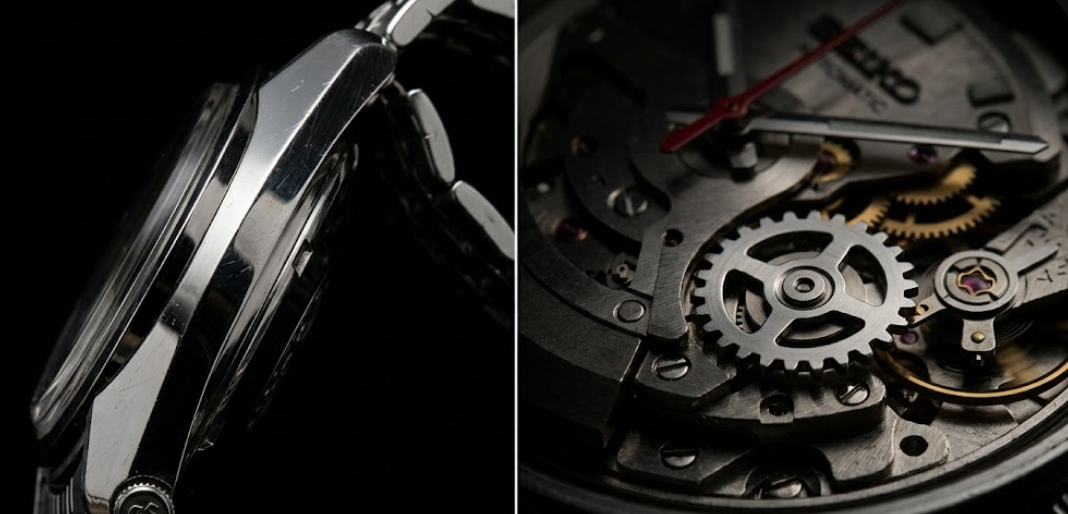
If you have spent any serious time in this hobby, you have probably had the conversation. Someone mentions they collect vintage Japanese watches and the response is a polite nod followed by a question about whether they have considered something Swiss. The implication being that Japan is where you start, not where you end up.
I have had that conversation many times. I no longer find it irritating. It just confirms that the person has not yet held a properly finished Grand Seiko from the 1960s, or opened the case back on a Citizen Chrono Master to see the movement inside, or understood what it means that Seiko — Seiko alone, among all the world's watch manufacturers — designs and produces every single component of its watches in-house, from the mainspring to the quartz crystal.
Japan produces some of the finest watches ever made. Not comparable to the finest. Not a credible alternative to the finest. Among the finest, full stop. Understanding why requires going back to how Japanese watchmaking developed, what it is built on, and what it has consistently produced.
How Japanese Watchmaking Was Built
The foundation was laid in 1881, when a 21-year-old entrepreneur named Kintaro Hattori opened a shop in Ginza to sell and repair imported timepieces. In 1892, he established the Seikosha Factory — "House of Exquisite Workmanship" — in what is now the Sumida ward of Tokyo. From the beginning, the production method integrated almost all processes in-house: movements, dials, hands, and exterior parts, all produced by the same organisation. This was not a manufacturing convenience. It was a deliberate philosophy of control.
By 1913, Seikosha had produced Japan's first domestically manufactured wristwatch, the Laurel. The transition from pocket watches to wristwatches required significant advances in microfabrication; downsizing movements to the 12-ligne size (26.65mm) was a genuine engineering challenge, and meeting it refined the factory's precision capabilities in ways that would pay dividends for decades.
In the postwar period, the Japanese timepiece industry rebuilt rapidly. A Ministry of International Trade and Industry watch competition, begun in 1948, created a rigorous testing environment that pushed the entire industry toward higher quality standards. By 1955, the overall level of the Japanese timepiece industry had improved significantly. By 1960, most domestically manufactured watches had reached world standards — and Seiko marked that achievement by launching the first Grand Seiko, explicitly positioned to rival the best Swiss luxury watches of the era.
Citizen was following a parallel path. Founded as the Shokosha Watch Research Institute in the early 1920s, the brand developed its own in-house movement architecture and expanded aggressively into export markets. Orient, established in 1950, became the third major player — producing in-house movements at competitive prices for a domestic market that expected mechanical reliability as a baseline requirement rather than a premium feature.
What distinguished these manufacturers from their Swiss counterparts was precisely the industrial philosophy that built them. The Swiss watchmaking tradition is collaborative and distributed: movement ébauches sourced from specialist suppliers, cases from dedicated case makers, dials from specialist houses. This creates extraordinary specialisation and, at the top end, extraordinary objects. But it also creates dependency and limits the degree to which any single manufacturer fully controls its output.
Japan took the opposite approach. Vertical integration — the complete in-house manufacture of every component — was not just a business model but a cultural tenet rooted in what the Japanese call monozukuri (モノヅクリ): the art of making things, with dedication and pride from start to finish. Alongside it, the principle of kaizen (改善) — continuous improvement through incremental refinement — shaped a manufacturing culture that updated and refined its processes generation after generation, without fanfare.
The Technical Achievements That Changed Watchmaking
1969: The Watch That Restructured an Entire Industry
On Christmas Day, 1969, Seiko released the Astron 35SQ — the world's first commercially available quartz wristwatch. The Astron achieved an accuracy of ±5 seconds per month, roughly 100 times more accurate than the finest mechanical chronometers of the day. The original price was 450,000 yen, roughly equivalent to a Toyota Corolla at the time.
The impact was not immediate, but it was decisive. The following decade brought what became known as the Quartz Crisis: Japanese manufacturers, spearheaded by Seiko, Citizen, and Casio, mass-produced quartz watches that undercut Swiss exports in both price and performance. By 1977, a mere eight years after the Astron's debut, Seiko had become the world's largest watch company by revenue. By 1978, quartz watches globally had overtaken mechanical watches in unit sales.
Swiss watch companies, which had numbered around 1,600 at the crisis's start, were reduced to a fraction of that number by its end. The industry survived through a pivot to luxury positioning, repositioning mechanical watches as art objects rather than precision instruments — a narrative that still shapes the marketing of Swiss watches today.
What this history tells us about Japanese watchmaking is important. The industry did not simply produce a popular product. It produced a genuine technological advance that forced an entire competing industry to reinvent itself. That is not the output of a second-tier manufacturing culture.
The Internal Competition That Built Grand Seiko
The Grand Seiko story involves a detail that most collectors outside Japan do not know: the internal rivalry between Seiko's two main factories.
Seiko's Suwa Seikosha division (now Seiko Epson) and its Daini Seikosha division (now Seiko Instruments) competed against each other directly throughout the 1960s and 1970s. Both produced Grand Seiko and King Seiko watches using different movement architectures; both developed proprietary finishing techniques. The internal competition was, in effect, a private arms race in precision watchmaking — and the products it generated were exceptional.
The Grand Seiko movements from this period — the 56xx family running at 21,600 bph, the 61xx family at 36,000 bph (Hi-Beat), and later the 56xx and 52xx variants with their multiple adjustment standards — represent a sustained investment in accuracy and finishing that few manufacturers anywhere have matched. The 17-day testing process under six positions and three temperatures that Grand Seiko applies to its movements today is documented as more demanding than COSC chronometer certification; the same rigour, in different form, shaped the vintage movements as well.
Spring Drive: An Answer Nobody Else Has Given
In the late 1970s, an engineer named Yoshikazu Akahane at Seiko's Suwa branch began working on a concept in his spare time: a mechanical watch as precise as a quartz one. The idea, reportedly inspired by watching a bicycle descend a hill at controlled speed by braking, was to regulate a mechanical movement's energy output using an electromagnetic brake rather than a traditional escapement.
After 28 years of development and approximately 600 prototypes, the first Spring Drive caliber was released commercially in 1999. The automatic version, Caliber 9R65, followed in 2004 with a 72-hour power reserve and accuracy of ±1 second per day — roughly 15 times better than a COSC-certified chronometer. In 2025, the Spring Drive U.F.A. Caliber 9RB2 achieved ±20 seconds per year, making it the most accurate mainspring-driven wristwatch ever produced.
No other manufacturer in the world makes anything like the Spring Drive. That is not a marketing claim. It is a technical fact. It represents the kind of patient, long-term engineering investment that is possible within a vertically integrated company with a deeply embedded culture of continuous improvement — and it is the modern expression of a philosophy that was shaping Japanese watchmaking long before any of the vintage pieces now collected were made.
What Japanese Craftsmen Actually Do Differently
Zaratsu: The Finishing Technique Most Watch Media Gets Wrong
Zaratsu polishing is often described in ways that make it sound mythological — a centuries-old samurai technique repurposed for watchcases. The reality is more interesting, and more honest.
In the early 1950s, Seiko acquired polishing machines for their Hayashi Seiki facility. The machines were manufactured by a German company called Gebr. Sallaz, and their phonetic pronunciation in Japanese — "zarats" — gave the technique its name. The key difference from other polishing methods is the use of the front face of the rotating polishing disk rather than the side, which allows for greater uniformity. The result is a case surface that is flat, mirror-bright, and entirely free of distortion at the edges where polished and brushed surfaces meet.
The technique requires years of practice to master. Each polisher fabricates their own holding jig to suit their particular working style. It cannot be automated, and its results are perceptible in person in a way that photographs consistently fail to capture. While the technique may have Swiss origins, it has largely been lost in Swiss industry and has become the signature of Japanese watchmaking — used not only across Seiko Corporation brands but by Citizen in its higher-end pieces as well.
On a vintage Grand Seiko or King Seiko case from the 1960s or 1970s, the Zaratsu surfaces still hold their definition after five or six decades. That is a statement about both the craft and the materials.
The Dial as an Art Form
Swiss watchmaking has a long tradition of grand feu enamel dials and minute repeater mechanisms. Japan's complementary tradition is in surface treatment: the manipulation of light, texture, and material to create dials that change character across different lighting conditions.
The Grand Seiko Snowflake dial — reference SBGA211, introduced in 2010 and inspired by the surface of snow observed near the Shinshu studio in winter — is the well-known modern example. But the vintage equivalents are everywhere if you look. The sunburst finishing on a 1960s Citizen Chrono Master changes from silver to near-black depending on the angle. The horizontally brushed dial of a vintage King Seiko catches light along its axis in a way that reveals the finish's direction. The deep blue of certain Lord Matic dials is a colour that only exists on these pieces; it cannot be replicated by a filter or a photograph.
Urushi lacquer dials — produced by traditional Japanese artisans using techniques developed over centuries for furniture and decorative objects — represent the highest expression of this tradition. The process involves multiple layers of lacquer, each dried and polished before the next is applied, over weeks of work. They are produced in very small numbers and appear on Grand Seiko and Credor pieces; they are among the most singular dial surfaces in all of watchmaking.
Why Vintage Japanese Watches Specifically
All of the above applies to Japanese watchmaking at large. The specific argument for the vintage era — roughly the late 1950s through the early 1980s — rests on an additional observation.
This was the period when Japanese manufacturers were competing hardest against each other and against Swiss benchmarks, with the full resources of their vertically integrated infrastructure applied to the problem. The competitive context produced extraordinary results. Seiko's internal factory rivalry created watches that neither division would have made independently. The postwar commitment to accuracy standards, driven by the government-sponsored watch competitions and by the explicit ambition to beat Switzerland, produced technical achievements that still surprise collectors who examine them for the first time.
The watches from this era are also products of an industrial moment that no longer exists. The factory configurations that made them, the specific movement families engineered in those decades, the particular culture of competitive in-house manufacture — all of that is history now. The objects that survive are the evidence.
What distinguishes them from Swiss watches of the same era is not superiority across every dimension. It is difference: a different industrial philosophy, a different set of aesthetic priorities, a different relationship between technical achievement and external presentation. Swiss watchmaking of the 1960s and 1970s was often more transparent about its complications, more invested in the visible display of mechanism. Japanese watchmaking from the same period was frequently more reticent — technically ambitious in ways that were not always immediately legible.
That restraint is itself a cultural expression, and it takes time to appreciate. But the collectors who arrive at it tend to stay.
Accessing the Market
A meaningful proportion of the most interesting vintage Japanese material remains within Japan. Japanese domestic market editions were never distributed internationally, estate clearances feed auction platforms that operate in Japanese only, and the dealer networks that hold the best inventory are largely unknown outside Asia.
For collectors based outside Japan, this creates a practical access problem. Yahoo! Auctions Japan and Mercari Japan are the largest sources by volume, but both require language ability or a proxy buyer, and condition grading practices vary considerably. The best vintage Japanese watches — the properly preserved examples with original dials, unpolished cases, and documented service histories — surface in Japan first.
Services such as Nivern exist specifically to close that gap, sourcing watches directly from Japanese marketplaces and trusted domestic dealers, handling authentication, and shipping internationally. For collectors interested in the JDM references that were never officially exported, this kind of direct Japanese market access is not a convenience. It is the only practical route.
Conclusion
The argument for Japanese vintage watches is not a contrarian one. It is a historical and technical one. Japan's watchmaking industry was built on a philosophy of complete in-house manufacture and continuous improvement. It produced some of the most significant technological achievements in the history of timekeeping. Its craft traditions — Zaratsu polishing, dial artistry, the patient engineering of the Spring Drive — are genuinely without parallel.
The vintage watches from Japan's most competitive era are the physical record of what that philosophy produced at its most ambitious. They were made by people who were trying to build the best watches in the world. Many of them succeeded.
The secondary market is still in the process of recognising this fully. That recognition, when it completes, will make some of the current prices seem improbable in retrospect. Until then, the opportunity remains.
FAQ
Why are Japanese vintage watches considered high quality? Japanese watchmakers — primarily Seiko, Citizen, and Orient — built their industry on complete in-house manufacture of every component, from movements to cases to dials. This vertical integration, combined with a manufacturing culture of monozukuri (dedication to craft) and kaizen (continuous improvement), produced watches of exceptional technical and finishing quality across all price tiers. The vintage era from the late 1950s through the early 1980s represents this philosophy at its most competitive.
What is Zaratsu polishing and why does it matter? Zaratsu polishing is a case-finishing technique used by Seiko and Citizen, derived from a German polishing machine (the Gebr. Sallaz) acquired by Seiko in the early 1950s. The name comes from the phonetic Japanese rendering of "Sallaz." The technique produces flat, mirror-bright case surfaces that are entirely free of distortion at edges, using the front face of a rotating polishing disk rather than the side. It requires years of skill to master and cannot be automated. On vintage Grand Seiko and King Seiko cases, the results remain visible after decades.
What is a JDM watch? JDM stands for Japanese Domestic Market. It refers to watch models produced by Japanese brands exclusively for the Japanese market, which often feature specifications, dial designs, or materials not available in internationally distributed versions. JDM watches are frequently better-specified than their international equivalents and command strong collector interest outside Japan precisely because they are difficult to source internationally.
What made Seiko's quartz watch historically significant? On December 25, 1969, Seiko released the Astron 35SQ — the world's first commercially available quartz wristwatch, achieving ±5 seconds per month accuracy, roughly 100 times more accurate than the best mechanical chronometers of the era. The technology triggered the Quartz Crisis, which reduced the Swiss watch industry from approximately 1,600 companies to a fraction of that number over the following decade and permanently restructured global watchmaking.
What is the Spring Drive movement? The Spring Drive is a movement type exclusive to Seiko and Grand Seiko, developed over 28 years by engineer Yoshikazu Akahane and first released commercially in 1999. It uses a traditional mainspring for power but regulates time using a quartz crystal and electromagnetic brake (the Tri-Synchro Regulator) rather than a conventional escapement. The automatic Caliber 9R65 achieves ±1 second per day accuracy. The latest Spring Drive U.F.A. Caliber 9RB2, introduced in 2025, achieves ±20 seconds per year — the most accurate mainspring-driven wristwatch ever made. No other manufacturer produces an equivalent.
Where can I buy vintage Japanese watches outside Japan? Western platforms including Chrono24 and eBay carry Japanese vintage watches, but at prices reflecting international demand and with inventory that represents what has been exported. The largest volume of material, including JDM exclusives and estate-sourced pieces, is available on Japanese domestic platforms such as Yahoo! Auctions Japan and Mercari Japan. For international collectors, specialist sourcing services like Nivern handle the process of identifying, authenticating, and shipping vintage Japanese watches directly from the Japanese domestic market.
Sources & References
- Seiko Museum Ginza — Stage 1: 1881–1920s Company History: museum.seiko.co.jp
- Seiko Museum Ginza — The Quartz Crisis and Recovery: museum.seiko.co.jp
- Seiko Watch Corporation — Our Heritage: seikowatches.com
- Grand Seiko Official — Spring Drive: Five Stories of the Pursuit of Precision: grand-seiko.com
- Grand Seiko Official — Introducing Spring Drive U.F.A. (Caliber 9RB2): grand-seiko.com
- Time and Tide Watches — "What Is Zaratsu Polishing?" (July 2025): timeandtidewatches.com
- Deployant — "Inside Seiko: Shiojiri — Cold Forging, Zaratsu and the 9F": deployant.com
- Revolution Watch — "The Revolutionary List: 30 Pioneering Watches — the Grand Seiko Spring Drive SBGA001" (December 2025): revolutionwatch.com
- Teddy Baldassarre — "Grand Seiko Spring Drive Guide" (March 2026): teddybaldassarre.com
- Man of Many — "The Incredible History of Grand Seiko's Spring Drive Movement": manofmany.com
- Ottuhr — "How the Quartz Crisis Nearly Ended Swiss Watchmaking" (March 2026): ottuhr.com
- The Hour Markers — "When Seiko Shocked Switzerland: First Quartz" (November 2024): thehourmarkers.com
- The Hour Markers — "The Zen of Collecting: Discovering the Soul of Japanese Watchmaking" (April 2026): thehourmarkers.com
- Chrono24 Magazine — "Japanese Watches That Fly Under the Radar" (September 2025): chrono24.com
- Chrono24 Magazine — "Seiko Watches: Japanese Precision and Innovation" (August 2025): chrono24.com
- Soldat Watch — "Japan's Quartz Revolution and Its Impact on the World of Horology" (July 2022): soldatwatch.com
- Soldat Watch — "Monozukuri is Japan's Dedication to Create High-Quality Products" (July 2022): soldatwatch.com
- Maeslux — "The History of Japanese Automatic Movements in Fine Watchmaking" (April 2026): maeslux.com