How to Spot a Fake Vintage Seiko
The vintage Seiko market has a problem that nobody talks about loudly enough. It is not a new problem, but it has grown in direct proportion to the category's rising profile. As prices for references like the 6139 Pogue, the 6105 diver, and the 6138 Panda have climbed over the past decade, the incentive to pass off fake, re-dialled, or part-swapped watches has grown alongside them.
The threat is not primarily outright counterfeits — those exist, but they are easier to detect than what more experienced collectors actually encounter. The real risk in vintage Seiko collecting is the "Frankenwatch": a genuine Seiko case with an incorrect or aftermarket dial; a correct dial in the wrong reference caseback; hands from a different model line installed by a watchmaker who had the right movement but not the right parts. These assembled watches are sold on eBay, sometimes on Chrono24, occasionally even through dealers who don't specialise in vintage Japanese pieces. They are sold sometimes in ignorance, sometimes deliberately, and they are responsible for a significant portion of collector disappointment in this space.
The good news is that vintage Seiko authentication is learnable. Seiko's manufacturing system is, in many respects, the authenticator's best friend: the company encoded remarkable amounts of information directly into every watch, and the collector community has documented that system in considerable depth over the past twenty years. Here is what you need to know.
Understanding Seiko's Reference Number System
Before you can identify a fake vintage Seiko, you need to understand how Seiko identified its watches internally, because this system is the foundation of all authentication.
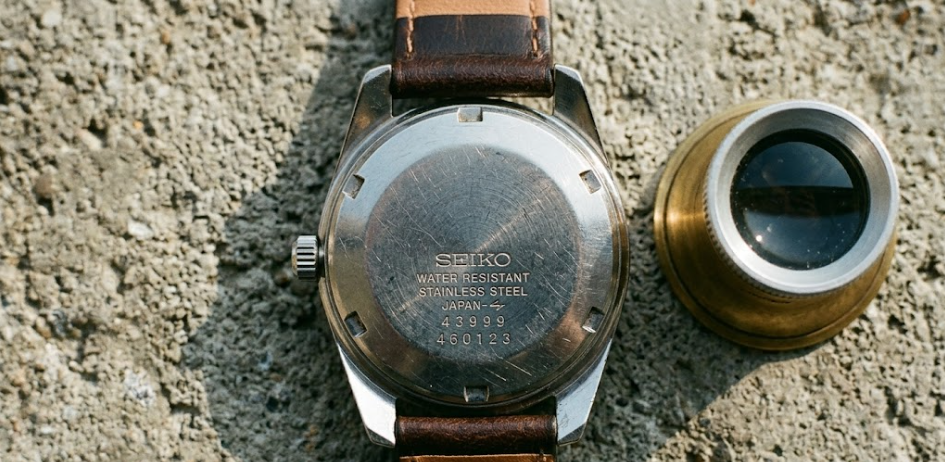
Every vintage Seiko caseback carries an eight-digit reference number in two four-digit groups separated by a hyphen. The format is: movement calibre number – case/model number. So a reference reading 6139-6002 tells you: this watch uses the 6139 movement (Seiko's automatic chronograph calibre, the world's first), housed in case configuration 6002 (yellow dial, rotating inner bezel, 40mm stainless case).
Both numbers matter. The movement calibre tells you what should be inside the watch. The case number tells you what the watch should look like on the outside — the dial configuration, case shape, and bracelet type that correspond to this specific reference. If either number is wrong for what you're looking at, you have a problem.
Below the hyphenated reference number, you will find a separate six or seven-digit serial number. This encodes the watch's production date: the first digit represents the last digit of the production year, and the second digit represents the production month (1–9 for January through September; 0 for October; N for November; D for December). So a serial number beginning with 3N indicates production in November of a year ending in 3 — 1973 being the most likely candidate for a 6139, given that calibre's production years.
Pre-1970 Seiko models use seven-digit serial numbers rather than six. The structure is otherwise consistent.
The serial number and the reference number are not the same thing, and conflating them is one of the most common errors first-time vintage buyers make. The serial number dates the watch. The reference number identifies what it is.
Cross-referencing these two numbers against documented production data is the first step in any vintage Seiko authentication. If a watch with a 6139-6002 caseback carries a serial number suggesting production in 1985, something is wrong: the 6139 was discontinued years before that. Online tools like the Seiko date finder at WatchSleuth and RetroSeiko's serial decoder allow anyone to input a calibre number and serial number and retrieve a production date estimate.
Reading the Dial Code: The Second Line of Verification
Turn a vintage Seiko face-up and look near the 6 o'clock position on the dial. You will find a small stamped or printed code, typically a four-character combination of numbers and letters. This is the dial code, and it is not decoration.
The dial code identifies the specific dial variant used in this watch. For the 6139 chronograph, for instance, a 6030T dial code on a watch with a -6002 caseback tells you the dial was made for the Suwa factory ("T" is the Suwa factory identifier), and the 6030 designation specifies the dial configuration. A 6030R would indicate a Daini factory dial. Cross-reference the dial code against the caseback reference to confirm they are correct for each other.
This is where one of the most useful and least-known authentication checks for vintage Seiko comes in.
The Suwa vs. Daini "A" Font Difference
Seiko's two manufacturing divisions — Suwa Seikosha (which produced Grand Seiko, among others) and Daini Seikosha — used slightly different fonts on their dials. The difference is in the letter "A" in the word "JAPAN" printed along the lower edge of most vintage dials.
Suwa dials use a flat-topped "A" — the crossbar of the letter meets a flat horizontal cap.
Daini dials use a pointed "A" — the letter comes to a peak at the top.
The dial code also identifies the factory: a "T" suffix indicates a Suwa dial; an "R" suffix indicates Daini. These should be consistent. A "T"-coded dial (Suwa) should have a flat "A." A "R"-coded dial (Daini) should have a pointed "A." If the factory code and the "A" shape disagree, the dial is either a replacement from the wrong factory or, more likely, an aftermarket fake.
This check alone will identify a significant proportion of fake dials on the 6138 Panda chronograph and other popular references where aftermarket dial production is known to be active. According to Provenance Watches, which documented this in detail in 2024: checking eBay listings for the 6138-8020 Panda at random, three out of six consecutive listings showed "T" dials paired with the incorrect pointy "A" — dials that should not exist in that configuration.
The Caseback Is Your First Inspection Point
Before you look at the dial at all, the caseback deserves its own examination. On a genuine vintage Seiko:
Engravings are clean, even, and precisely spaced. The reference number, serial number, and other text — water resistance rating, case material, country marking — should be laser-clean in their impression. Characters should be uniformly sized, evenly spaced, and consistently deep. Rough, uneven, or shallow engravings indicate either a replacement caseback or, in the case of outright fakes, mass-produced stamping that cannot replicate factory precision.
The serial number should be coherent with the reference. As covered above, use the serial decoder to confirm the production date is plausible given the reference number's known production window.
The Suwa "typhoon" or Daini "lightning bolt" emblem should be present on appropriate references. Many higher-grade Seiko domestic references carry a factory emblem on the caseback — the Suwa typhoon (a stylised spiral) or the Daini lightning bolt. The dial should carry a matching mark. If the caseback emblem and the dial factory identifier disagree, components have been mixed.
The Japan country marking should read correctly. The format varies by period and case origin. Mismatched country markings between the dial and caseback are a flag.
The Movement: Opening the Caseback
For any significant purchase, the movement should be examined. This requires opening the caseback — which should be done by a watchmaker unless you have appropriate tools and experience — but the information available inside is definitive.
The movement rotor of a genuine vintage Seiko will be signed, typically with the calibre designation and "Seiko" or the relevant factory identifier. The movement itself will match the calibre number on the caseback.
The most important check here is simple: does the movement inside match the four-digit calibre number on the caseback? A caseback reading 6139-6002 should contain a 6139 movement. A generic Chinese automatic, a different Seiko calibre, or any movement that does not correspond to the caseback reference is a definitive authentication failure. This is the single clearest tell for an outright fake, as opposed to a Frankenwatch assembled from genuine parts.
On authentic vintage movements, the jewel count and specification should match documented data for that calibre. The 6139, for instance, is a 21-jewel column-wheel chronograph. If you see 17 jewels on the bridge, the movement has been replaced.
Dial Authentication: What to Look For in Hand
Dials are the hardest component to authenticate remotely, and the most commonly faked. Here is what to examine.
Lume Condition and Application
Original vintage Seiko lume — applied radium, tritium, or Super-LumiNova depending on the production era — ages with a characteristic consistency. Tritium (used through the 1990s) develops a cream or pale yellow patina across all applied indices simultaneously. An original dial will show even ageing across all lume plots; a re-lumed or partially restored dial will show inconsistencies — some indices patinated, some bright white, or uneven surface texture between plots.
On genuine vintage diver bezels, the lume pip at the 12 o'clock position is recessed slightly below the surface of the bezel insert. Aftermarket and replacement inserts typically feature a flat or even raised pip. This is a quick check on any vintage Seiko diver and reliable enough that it has been documented as a primary authentication tell by the WatchEra authentication community.
Printing Quality and Font Consistency
The text on a genuine Seiko dial — brand name, model designation, calibre code, water resistance rating — is applied with factory precision. The Seiko logo will be bold, evenly weighted, and sharply defined at the edges. Text lines will be parallel to each other and to the dial's horizontal axis. Spacing between characters will be consistent.
Aftermarket dials cannot consistently replicate this. Common tells include:
- Text that appears slightly blurry or soft-edged under magnification
- Uneven character spacing, particularly in the word "AUTOMATIC" or "CHRONOGRAPH"
- Incorrect font weight — either too thin or too bold — compared to documented originals
- Misalignment between text lines, with one line visibly not parallel to another
The "5" character is a particularly reliable tell: fake dials frequently render the "5" in a font that is observably incorrect when compared to genuine period dials under magnification.
The Dial Code and Date Stamp
The dial code near 6 o'clock should be consistent with the caseback reference as described earlier. On the back of the dial itself — visible only when the movement is removed — most vintage Seikos carry a two-digit date stamp indicating the month and year of dial manufacture. This should be consistent with the watch's serial number. A dial datestamped several years before or after the watch's production date is a sign of component mixing.
Identifying Frankenwatches: Parts That Don't Belong
A Frankenwatch is a watch assembled from genuine components that do not belong together — a correct dial in the wrong caseback, correct hands from a different reference, or a genuine movement in an incorrect case. These are not outright fakes in the traditional sense, but they represent a fundamentally misrepresented watch that is worth less than its components suggest when properly matched.
The methodology for identifying a Frankenwatch is systematic cross-referencing:
Does the dial code match the caseback reference? The last four digits of the caseback reference number should correspond to the dial code family. A 6139-6002 caseback should carry a 6030-series dial, not a dial coded for a -6010 or -6031 reference.
Are the hands correct for this specific reference? Hand styles in the 6139 series varied by reference and year. Chrono hand colour, lume window presence, and baton vs. leaf hand shapes are all reference-specific. Consulting documented examples from reputable dealer listings or collector database photos is necessary to confirm hand correctness.
Does the day/date wheel language match the reference? Some 6139 references were produced with English/German day wheels, some with English/Japanese (Kanji). The caseback J marking (JAPAN J) indicates Japanese-spec production; these watches should carry Kanji wheels. English/German wheels on a JAPAN J-marked caseback is a mismatch.
Is the inner chapter ring present where it should be? Certain 6139 references (the 6139-600x series, including the Pogue) feature an inner rotating bezel/chapter ring. The 6139-8000 series does not. The presence or absence of this component is reference-specific and a common mixing point.
Red Flags When Buying: Practical Purchasing Guidance
"NOS," "MINT," or "UNWORN" condition claims on 50-year-old watches. These claims are occasionally legitimate — watches do emerge from old stock — but they are also among the most consistently misused terms in vintage listings. A 1972 Seiko in genuinely unworn condition is extraordinarily rare; most examples described this way have been cleaned, re-lumed, or polished to remove visible wear. Treat such claims with scepticism and look for normal patina consistent with the watch's age.
Photographs that avoid the caseback. Any listing without a clear caseback photograph — the reference number fully legible, the serial number visible — should prompt a request for that image before purchase. A seller who is reluctant to provide caseback photos is either hiding something or doesn't understand what they have, neither of which is reassuring.
Price that seems dramatically low for a sought-after reference. Market pricing for established vintage Seiko references is reasonably well-documented on WatchCharts, Chrono24, and through sold listing research on eBay. A Pogue-reference 6139 at a third of current market pricing warrants extremely close examination. The probability that it is either incorrect or significantly misrepresented is high.
Sellers who cannot describe the specific reference number. The ability to state the precise caseback reference — not just "it's a Pogue" or "it's a 6105 diver" but the specific four-digit second group — is a basic marker of seller knowledge. A seller who doesn't know or cannot find their reference number is one who has not done the research you are about to rely on them for.
The Case for Buying from Verified Sources
The authentication process described in this article requires time, knowledge, and in some cases physical access to the watch. For collectors who are building expertise, going through this process with every purchase is genuinely educational. For collectors who are acquiring higher-value vintage pieces without direct prior experience in a specific reference, the risk calculation is different.
Physical inspection before purchase remains the most reliable form of authentication. Reputable dealers who specialise in vintage Japanese watches — who have handled enough examples to know what correct parts look like in hand — provide authentication through their own process before a watch reaches a buyer. Services like Nivern, which source watches directly from the Japanese market and apply reference-specific verification before international shipping, operate similarly: the authentication work is done before the purchase is complete, not after.
For anyone navigating the broader grey market — eBay, Chrono24 listings from unknown sellers, general Japanese auction platforms without specialist oversight — the tools in this article are essential. And when in doubt on a significant purchase, the collector community remains one of the best resources: The Watch Site's vintage Seiko forum, the Seiko & Citizen Watch Forum (SCWF), and WatchUSeek's vintage section all have active and knowledgeable members who will review photographs and offer informed opinions on authenticity.
Conclusion
Spotting a fake vintage Seiko is not a matter of intuition, though that does develop with experience. It is primarily a matter of systematic cross-referencing: does the caseback reference match the dial code? Does the serial number place production within the reference's known window? Does the movement inside correspond to the calibre number on the caseback? Do the hands, day wheel, and chapter ring match documented examples of this specific reference?
The Suwa-Daini "A" font difference. The recessed lume pip. The two-digit dial date stamp. The consistency between the factory emblem on the caseback and the factory identifier in the dial code. These are not esoteric details — they are the things Seiko built into every watch it made, and they remain readable fifty years later.
Vintage Seiko collecting rewards the prepared buyer. The authentication tools are available, the community knowledge is documented, and the genuine examples — when correctly identified — remain some of the best-value significant watches in the market. Getting there requires doing the work. This is where you start.
FAQ
What is a Frankenwatch in vintage Seiko collecting? A Frankenwatch is a watch assembled from genuine Seiko components that do not all belong to the same reference — for example, a correct dial installed in the wrong model's caseback, or hands from a different reference fitted during service. These are worth less than properly matched examples of the same reference, even though all components may be genuine Seiko parts.
How do I read the reference number on a vintage Seiko caseback? The eight-digit reference number on a vintage Seiko caseback is formatted as two four-digit groups separated by a hyphen. The first four digits identify the movement calibre (for example, 6139 means the automatic chronograph calibre). The second four digits identify the specific case and dial configuration. Together, they define the exact reference.
How do I date a vintage Seiko from the serial number? The six-digit serial number on the caseback encodes the production date. The first digit gives the last digit of the production year; the second gives the production month (1–9 for January–September; 0 for October; N for November; D for December). Cross-referencing with the movement calibre's known production years helps confirm which decade applies. Online tools at RetroSeiko and WatchSleuth can automate this calculation.
What is the Suwa vs. Daini "A" font difference, and why does it matter? Seiko's two manufacturing divisions — Suwa Seikosha and Daini Seikosha — used slightly different typography on their dials. Suwa dials use a flat-topped "A"; Daini dials use a pointed "A." The dial code suffix (T for Suwa, R for Daini) should correspond to the correct "A" shape. A mismatch indicates an aftermarket or replacement dial, which is one of the most common forms of vintage Seiko fraud.
Are all "re-dialled" vintage Seikos fraudulent? Not necessarily — some re-dials are disclosed by sellers and priced accordingly. The problem arises when a re-dialled watch is presented and priced as completely original. A disclosed, sympathetically restored dial on a genuine watch is a different proposition from an undisclosed aftermarket dial passed off as factory-original.
What should I look for in a lume pip on a vintage Seiko diver? On an original vintage Seiko diver bezel, the lume pip at the 12 o'clock position sits slightly recessed below the surface of the bezel insert. An aftermarket or replacement insert typically has a flat or raised pip. This is a quick and reliable check on any vintage Seiko diver.
Is it safe to buy vintage Seiko watches on eBay? eBay contains genuine vintage Seiko watches alongside fakes, Frankenwatches, and misrepresented pieces. It requires careful application of the authentication steps in this article, particular attention to caseback photographs, and research on the specific reference before purchase. For high-value references like the 6139 Pogue or 6138 Panda, buying from known specialists or established collector-sellers significantly reduces risk.
Sources & References
- Provenance Watches — "How to Spot a Fake Seiko Dial" (Suwa/Daini factory font differences, dial code explanation, eBay authentication examples): https://provenancewatches.com/blogs/seiko-watch-blog/how-to-spot-a-fake-seiko-dial
- WatchEra — "How to Spot a Fake Vintage Seiko Watch" (dial code reading, lume pip authentication, condition warnings on "NOS" claims): https://watchera.nl/blogs/seiko-information/how-to-spot-a-fake-vintage-seiko-watch
- Vintage Watch Advisors — "Frankenstein's Seiko (One of Many)" (Frankenwatch case study, dial code dating, component mixing documentation): https://www.vintagewatchadvisors.com/blog/2024/01/02/frankensteins-seiko-one-of-many/
- Vintage Watch Advisors — "Seiko Pogue Authentication Part II: Dials" (6139 dial variant documentation, dial code reference guide): https://www.vintagewatchadvisors.com/blog/2019/07/20/seiko-pogue-authentication-part-ii-dials/
- Plus9Time — "Deciphering Seiko Case Back Information" (case back format, serial number structure, country marking explanation): https://www.plus9time.com/seiko-case-back-information
- RetroSeiko — Seiko Serial Number to Manufacture Date Decoder (online tool for production date calculation): https://retroseiko.co.uk/seiko-serial.htm
- WatchSleuth — Seiko Date Finder (serial number plus calibre dating tool): http://www.watchsleuth.com/seikodatefinder/
- Millenary Watches — "Seiko Serial Numbers Complete Guide and Date" (format explanation, caseback code guide): https://millenarywatches.com/seiko-serial-number/
- Seikoworldtime.com — "Decoding Seiko Case Back and Part Numbers" (model number decoder, case and dial code relationships): https://www.seikoworldtime.com/articles/Seiko_Codes_And_Part_Numbers
- ReWrist — "How to Read a Watch Caseback: Reference Numbers and Hallmarks" (Seiko reference number format context): https://www.rewrist.com/blogs/news/how-to-read-a-watch-caseback-reference-numbers-serials-and-hallmarks
- Adventures in Amateur Watch Fettling — "An Homage to a Modified Seiko 6105" (first-person account of purchasing a Seiko 6105 with a fake dial): https://adventuresinamateurwatchfettling.com/2022/08/12/an-homage-to-a-modified-seiko-6105/
- Omega Forums — "Seiko 6105-8110 Questions/Help" (6105 date window authentication tell, bezel authentication discussion): https://omegaforums.net/threads/seiko-6105-8110-questions-help.69304/
- WatchUSeek — "I Need Help Figuring Out if This Is a Real, Fake, or Modified 6139" (community authentication of 6139 Frankenwatch example): https://www.watchuseek.com/threads/i-need-help-figuring-out-if-this-is-a-real-fake-or-modified-6139.5263102/
- WatchUSeek — "SEIKO 6139-6002 Authenticity Check" (dial code discrepancy discussion, real-world authentication example): https://www.watchuseek.com/threads/seiko-6139-6002-authenticity-check.4859147/
- Provenance Watches (Substack) — "Modified Watches vs Fake Watches: Re-Dials" (distinction between disclosed restorations and fraudulent re-dials): https://provenancewatches.substack.com/p/modified-watches-vs-fake-watches
- namokiMODS — "How to Spot a Knockoff or Fake Seiko" (caseback code mismatches, font authentication on modern references): https://www.namokimods.com/blogs/namokitimes/how-to-spot-a-feiko-pay-attention-to-these-9-things