How to Buy Watches from Japan: A Practical Guide
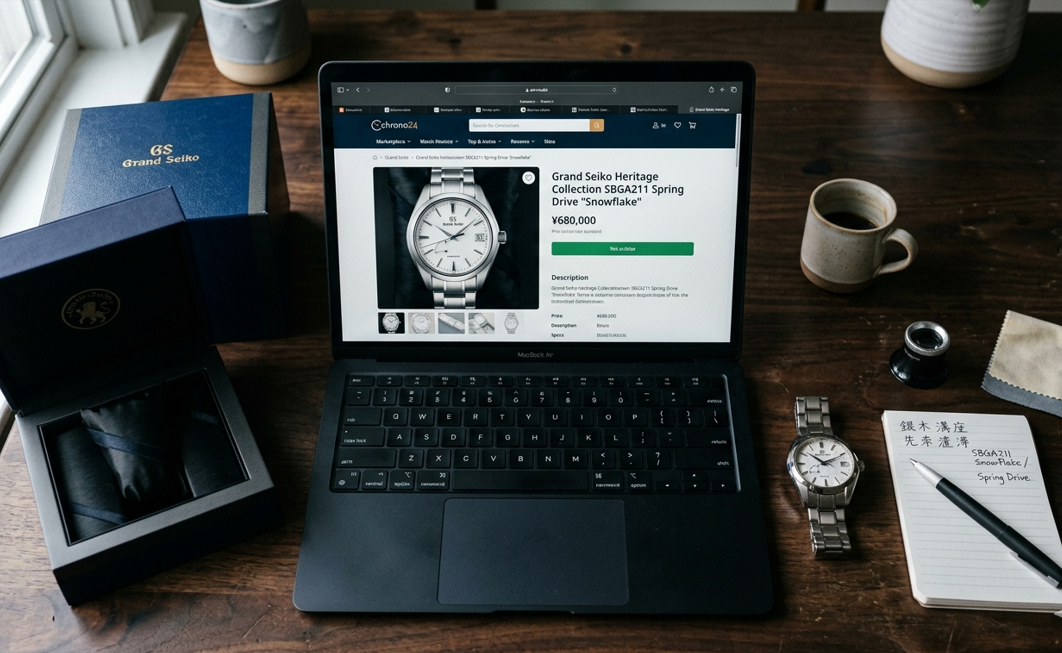
Most collectors, at some point, end up here: you've found the reference you want, and the only real inventory for it is sitting in Japan. The listing photos are clear, the condition looks right, the price makes sense after conversion — and then the reality of sourcing it sets in. Japanese address required. Japanese payment infrastructure. No international shipping option. The listing might disappear in the time it takes you to figure out how the platform works.
Buying watches directly from Japan is genuinely manageable, but it requires understanding a few distinct things at once: which platform you're on, what the buying process actually looks like, what the total landed cost will be after shipping and duties, and where the real risks live. This guide covers all of it.
Why Buy Watches Directly from Japan?
The case is straightforward and worth stating plainly before getting into logistics.
Japan has one of the deepest secondhand watch markets in the world. The combination of strong domestic consumption, careful ownership habits, and a well-developed resale culture means that watches in Japan tend to be preserved exceptionally well. Condition described as "used" by a Japanese seller is frequently what a Western seller would call near-mint. Original boxes, papers, and accessories are retained at rates that are genuinely uncommon elsewhere.
Beyond condition, the selection itself is unmatched for certain categories. JDM (Japanese Domestic Market) references — watches produced by Seiko, Citizen, Casio, and Orient exclusively for their home market — exist in meaningful volume in Japan and almost nowhere else legitimately. Vintage Japanese watches from the 1960s through the 1980s surface regularly on domestic platforms in quantities and variety you won't find on Chrono24 or eBay. Even for non-Japanese watches, Japanese collectors have historically purchased broadly and stored well; finding a clean European or American vintage piece through a Japanese secondhand platform is not unusual.
The yen's relative weakness against the dollar and euro in recent years has made Japanese inventory even more attractive on a price-adjusted basis, though exchange rates fluctuate and should never be the primary reason for a purchase.
Understanding the Japanese Watch Market: Where Things Are Sold
Yahoo! Auctions Japan
Yahoo! Auctions Japan — commonly abbreviated as YAJ — is the dominant auction platform for secondhand goods in Japan. Volume is high, and the watch category is extensive. You'll find everything from ¥2,000 Casio quartz pieces to high-value Grand Seiko references, vintage Swiss pieces, and rare JDM models that haven't surfaced on international platforms in years.
The platform operates primarily in Japanese. Listings require careful reading (or translation) because condition descriptions matter enormously, and Japanese sellers use a consistent grading shorthand — terms like gaitou nashi (no box), moji ban ni surikizu (scratches on dial), and grade descriptors like "S rank" or "N" (new/unused) — that a Google Translate pass can miss or misrender. Most sellers on YAJ do not ship internationally, which is where proxy services come in.
Prices on YAJ reflect real market demand. There are deals, particularly on less-followed categories, but popular references are bid up appropriately by a knowledgeable domestic buyer pool.
Mercari Japan
Mercari Japan is a consumer-to-consumer marketplace, closer in format to the fixed-price model of eBay's "Buy It Now" listings than to an auction. Pricing is set by sellers, negotiation is possible, and the platform has an enormous volume of watch listings ranging from casual to serious.
For collectors, Mercari is useful for finding watches quickly at fixed prices without waiting for an auction to close. The trade-off is that seller knowledge varies more widely than on YAJ; listings from non-specialist sellers occasionally have condition descriptions that are optimistic, and authentication is the buyer's responsibility.
Like YAJ, Mercari Japan restricts purchases to accounts with Japanese addresses, making proxy services necessary for international buyers.
Rakuten and Amazon Japan
Both platforms host professional dealers and retailers alongside individual sellers. Rakuten in particular has a number of established watch dealers operating storefronts, and some of these ship internationally or work with English-speaking buyers. For new or near-new JDM stock from known sellers, these can be simpler options than auction platforms — less friction, more predictable condition. Pricing tends to be closer to retail, however.
Physical Shops in Tokyo
For collectors who visit Japan, the physical watch market is worth understanding separately from the online one.
Nakano Broadway, a multi-floor shopping complex in western Tokyo reachable directly from Nakano Station on the Chuo Line, is the most concentrated single location for vintage watch dealers in the city. The third floor in particular houses multiple independent watch shops, some specialising in vintage Japanese pieces, others carrying Swiss and international brands. Kamekichi, one of the most respected dealers in the building, typically maintains several thousand pieces in stock across their main store and annex. These shops allow handling before purchase — which matters considerably for vintage pieces where condition details don't always translate to photographs.
Komehyo, a national secondhand luxury goods chain, operates branches across Tokyo including in Shinjuku. Their watch inventory skews toward popular international brands but regularly includes Japanese pieces; the advantage over independent dealers is consistent grading and professional presentation. Daikokuya operates similarly.
For travellers, purchasing from a physical retailer in Japan also allows for tax-free shopping on presentation of a passport — Japanese consumption tax (currently 10%) is waived for qualifying foreign visitors at participating stores, which represents meaningful savings on higher-value pieces.
How Proxy Services Work
For international buyers who cannot purchase directly on YAJ or Mercari Japan, proxy services are the standard solution. These services provide a Japanese address, handle the purchase transaction on your behalf, receive the item at their warehouse, perform a basic condition check, and then forward the package internationally.
Well-established proxy services in the watch collecting community include Buyee (which has official integration with Yahoo Auctions and Mercari), Remambo, ZenMarket, and FromJapan. Each differs in fee structure, storage duration, inspection quality, and reliability. For high-value watch purchases specifically, services that offer condition photography after receipt — so you can verify what arrived at their warehouse before it ships internationally — are worth prioritising.
The fee structure across proxy services typically includes: a service fee per transaction (often a flat fee or percentage of the item price), warehouse storage (most services offer some free storage period), domestic Japanese shipping from seller to warehouse, and then international shipping. On a mid-range watch purchase, proxy fees and shipping might add ¥3,000–¥8,000 (roughly $20–$55 USD at recent rates) before the international leg, which can be comparable or higher depending on the service and package weight. Understanding the full cost before committing to a purchase matters.
Proxy services also handle the currency conversion and payment to Japanese sellers. Most Japanese platforms require Japanese payment methods; the proxy service's local infrastructure handles this on your behalf.
Import Duties and Taxes: What to Budget For
This is where a significant number of first-time Japan buyers get surprised, and it's worth addressing directly.
Importing a watch into the United States is not straightforward from a duties calculation standpoint. Watches are assessed not as a single item but as a set of components — movement, case, and strap/bracelet — each taxed at different rates under the US Harmonized Tariff Schedule, with further distinctions based on material (stainless steel vs. precious metal) and movement type (battery-powered vs. mechanical). For a steel-cased mechanical watch, import duty in the US has typically fallen in a range of roughly 4–7% of declared value, though the precise calculation depends on how value is allocated between components. US Customs and Border Protection's de minimis threshold is $800 USD; watches below this value are generally not assessed duties.
For EU buyers, VAT is applied at import at the destination country's standard rate (typically 19–25% depending on country), plus any applicable customs duty. UK buyers face similar considerations post-Brexit. These are real costs and should be factored into purchase decisions. A watch that appears to offer a 15% saving over European grey market pricing may offer no saving at all once import VAT is included.
One practical note: courier services like DHL, FedEx, and UPS act as customs brokers by default, file the paperwork, and collect duties prior to delivery. EMS (Japan Post's express service) ships internationally but processes customs at the destination postal service, which historically has had lower duty assessment rates — though this is not guaranteed and should not be relied upon for compliance purposes. Declared values on customs forms should reflect actual transaction values; undervaluation creates legal exposure for the buyer.
Authentication: The Risk You Can't Ignore
The Japanese secondhand market has a reputation for authenticity that is, on balance, deserved — but it is not absolute, particularly for international buyers purchasing blind through proxy services.
The most commonly counterfeited Japanese watches in the international market are popular reference points: certain Grand Seiko models, vintage Seiko chronographs, and a handful of the more sought-after JDM references. For high-value vintage pieces specifically, condition details that matter for authentication — the text on a caseback, the condition of a dial's applied indices, the specific finishing of a movement rotor — do not always come through in auction photographs.
Buying from established dealers (rather than individual consumer sellers) on Rakuten, from well-regarded physical shops, or from services that employ watch-specific authentication expertise, reduces this risk materially. Consumer platforms like YAJ and Mercari involve more due diligence on the buyer's side.
This is one of the reasons many serious collectors outside Japan use dedicated sourcing services rather than navigating the proxy service route independently. Services like Nivern source watches directly from the Japanese market but apply authentication scrutiny before purchase, reducing the probability of a problem arriving after international shipping — at which point dispute resolution becomes considerably more complicated.
The Language Barrier and What It Actually Costs You
Using Google Translate or DeepL to read Japanese watch listings will get you perhaps 70% of the way there. For casual purchases of clearly described, well-photographed pieces, that's probably sufficient. For vintage or high-value pieces, the remaining 30% matters.
Japanese sellers on YAJ use a specific vocabulary for condition disclosure that doesn't map cleanly to English equivalents. Words and phrases describing wear on the crystal, marks on the case, condition of the movement, or the presence of service history carry precision in Japanese that translation tools sometimes flatten into ambiguity. A listing described in careful Japanese that notes bando no ura ni chiisana kizu ("small scratches on the reverse of the bracelet") and bun ni yore aru ("some ageing on the dial") tells a specific story. The same listing run through a translation service might read confusingly or lose one of those disclosures entirely.
For serious purchases, reading listings with care — spending time to identify the key condition disclosure phrases and cross-referencing them — is worth the extra time. When in doubt, using a buying service that reads Japanese natively eliminates this uncertainty entirely.
Common Mistakes Collectors Make When Buying from Japan
Ignoring total landed cost. The item price plus proxy fees plus international shipping plus import duties is what the watch actually costs. Calculating only the first number and being surprised by the rest is the most common practical error.
Trusting condition photographs from unfamiliar sellers without scrutiny. Japanese sellers are generally honest, but photograph quality varies and some disclosures are in descriptions rather than visible in images. For vintage or higher-value pieces, inadequate image sets are a reason to request more photographs, not proceed.
Assuming all proxy services are equivalent for watch purchases. General proxy services work well for goods where arrival condition can be verified easily by a non-specialist. Watches are different — a proxy warehouse employee taking a photograph of a watch box may not notice a cracked crystal, a re-dialled face, or a replaced crown. Watch-specific vetting matters for anything beyond a basic, well-documented purchase.
Underestimating service timelines. Purchasing via proxy, warehousing, international shipping, and customs clearance together can take three to six weeks in straightforward cases. Longer is common. Impatience leads to unnecessary shipping consolidation decisions and overpaying for faster options.
Over-relying on the condition reputation of Japanese sellers as a category. The reputation is earned and broadly accurate, but it describes the average. Individual listings still need individual evaluation.
Who This Process Is For
The honest answer is that navigating Yahoo Auctions Japan through a proxy service, reading Japanese condition descriptions, calculating landed costs, and managing customs clearance is a reasonable process for collectors who have done some preparation and are buying at a deliberate pace. It works better for people who know the reference they want, have done market research, understand what good condition looks like for that piece, and aren't in a hurry.
For collectors newer to Japanese sourcing, starting with established English-language retailers who specialise in Japan — or with sourcing services that handle the full process, like Nivern — makes more practical sense than attempting to navigate every moving part simultaneously on a first purchase.
Conclusion
The Japanese watch market is genuinely one of the most compelling sources of inventory for serious collectors, and the barriers to accessing it are lower now than they were a decade ago. Platform infrastructure, proxy services, and international shipping options have improved considerably. What hasn't changed is the need for careful research, accurate cost accounting, and appropriate scrutiny for high-value or vintage purchases.
The watches are there. Getting to them efficiently and without expensive mistakes is primarily a matter of understanding the landscape well enough to make informed decisions at each step — platform choice, proxy selection, condition verification, and cost calculation included. For collectors willing to invest that time, Japan remains an exceptional source. For those who'd prefer someone else to handle that groundwork, good sourcing services exist for exactly that purpose.
FAQ
Do I need to speak Japanese to buy watches from Japan? No, but it helps materially for higher-value or vintage purchases. Proxy services handle the transaction mechanics, but reading condition descriptions accurately — particularly the standard disclosure language Japanese sellers use — reduces risk and occasionally surfaces important information that translation tools miss.
What is the safest platform for buying watches from Japan? For new or near-new stock, established retailers on Rakuten or shopping in person at reputable Tokyo dealers offers the most straightforward authentication path. For secondhand and vintage, Yahoo Auctions Japan has the deepest inventory; the trade-off is that buyers accept more individual responsibility for condition verification.
How much do proxy service fees add to the total cost? This varies by service and depends on the transaction value and shipping weight. As a rough estimate, plan for proxy service fees, domestic Japanese shipping, and international shipping to add approximately ¥3,000–¥10,000 ($20–$70 USD at recent exchange rates) on top of the item price for a standard watch purchase, before any import duties at the destination.
Will I pay import duty on a watch purchased from Japan? Most likely, if the declared value exceeds your country's de minimis threshold. In the US this threshold is $800 USD; in the EU and UK, thresholds are lower. Duties on watches in most countries fall in a 4–10% range on assessed value, but the calculation depends on case material, movement type, and how value is allocated across components.
Is buying a watch via proxy service safe? Generally yes, with appropriate precautions. The primary risks are condition being different from listing photographs and, for higher-value pieces, authentication. Using a proxy service that offers post-receipt condition photography, and purchasing from verified dealers rather than unknown individual sellers for expensive pieces, addresses most of the risk.
How long does it take to receive a watch from Japan? Realistically, three to five weeks is a reasonable expectation for a proxy purchase: time for the proxy service to receive from the seller, consolidation period if you're waiting for multiple items, then international shipping (typically one to two weeks via EMS or express courier) plus customs clearance. Faster is possible; longer is also common.
What are alternatives to using a proxy service? Some Japanese retailers on Rakuten and Seiya Japan ship internationally and operate English-language interfaces. For specialised vintage and JDM sourcing, services that operate directly in Japan and handle sourcing, authentication, and shipping — such as Nivern — are an alternative to navigating the proxy service route independently.
Sources & References
- Buyee — Official proxy service with Yahoo Auctions and Mercari integration: https://buyee.jp
- Remambo — Japan proxy shopping and shipping service: https://www.remambo.jp
- Yahoo! Auctions Japan: https://auctions.yahoo.co.jp
- Mercari Japan: https://jp.mercari.com
- Tokyo Weekender — "Where to Buy Vintage Watches in Tokyo" (Nakano Broadway, Komehyo, dealer listings): https://www.tokyoweekender.com/things-to-do-in-tokyo/where-to-buy-vintage-watches-in-tokyo/
- Kamekichi Watch Shop, Nakano Broadway (store information): https://www.kame-kichi.com/foroverseas/en/shop.html
- WatchUSeek Forums — "Customs Fees from Japan into the US" (practical duty calculation discussion): https://www.watchuseek.com/threads/customs-fees-from-japan-into-the-us.5296801/
- WatchUSeek Forums — "Buying in Japan — Questions about US Customs" (tax-free shopping, duty experience): https://www.watchuseek.com/threads/buying-in-japan-questions-about-us-customs.5489888/
- Remambo Blog — "Where to Buy Second-Hand Watches in Japan": https://www.remambo.jp/articles/where-to-buy-second-hand-watches-japan
- US Harmonized Tariff Schedule (watch component duty rates): https://hts.usitc.gov
- Japan National Tax Agency — Consumption Tax and Tax-Free Shopping Information: https://www.nta.go.jp/english/index.htm
- Special Dial — "Guide to Watch Shopping in Nakano Tokyo": https://specialdial.com/blogs/news/guide-to-watch-shopping-in-nakano-tokyo